воскресенье, 18 августа 2019 г.

воскресенье, 11 августа 2019 г.
14,08,2019 (2.08.2019) cancelled (1650)
1. (To) Hit the books


Literally, hit the books means to physically hit, punch or slap your reading books. However, this is a common English idiom among students, especially American college students who have a lot of studying to do. It simply means “to study,” and is a way of telling your friends that you’re going to study. It could be for a final exam, a mid-term test or even an English exam.
“Sorry but I can’t watch the game with you tonight, I have to hit the books. I have a huge exam next week!”
2. (To) Hit the sack


Just like the first idiom, the literal meaning of this would be physically hitting or beating a sack (a large bag usually used for carrying things in bulk such as flour, rice or even soil). But actually to hit the sack means to go to bed, and you’d use this to tell your friends or family that you’re really tired, so you’re going to sleep. Instead of saying hit the sack you can also say hit the hay.
“It’s time for me to hit the sack, I’m so tired.”
1.35
1. Visitors are asked to abstain ___________ smoking on the premises.
(a) from (b) on
2. She is unavailable at the moment as she is attending _________ an urgent issue.
(a) on (b) to
3. I believe _________ him – he is such a talented and hard-working artist.
(a) with (b) in
4. She took some time off work to care ________ her sick son.
(a) for (b) of
5. I totally agree _______ your opinion – everything you say about this is true!
(a) with (b) for
6. The schoolboy was blamed _______ the broken window.
(a) about (b) for
7. He annoys me because he is always boasting __________ his achievements!
(a) about (b) with
8. The management team is meeting this afternoon to decide ___________ the best solution.
(a) on (b) for
p112 wb
RU 79-80 86-87
вторник, 6 августа 2019 г.
07.08.2019
A(AN) can be used like the word "per".
Examples:
- Apples currently cost $1.30 a pound.
- Cheetahs can run 60 miles an hour.
- You want $150 a person for the tour?
If a direction (north, west, southeast, left, right) directly follows a verb, do not use an article with the direction.
Examples:
- We need to walk south.
- They drove north all day.
- At the stop sign, turn left and walk three blocks.
HOWEVER: If a direction follows a preposition, you must use THE.
Examples:
- We need to walk to the south.
- Our house is in the north.
- The grocery store is on the right.
MOREOVER: Use THE with compass directions when referring to them as special geographic or cultural regions.
Examples:
- We love the South.
- Have you ever visited the East?
- The West has better national parks.
вторник, 16 июля 2019 г.
17.07.2019
Эффект плацебо — какой-либо эффект, психологический или физический, который препарат плацебо (пустышка) оказывает на человека. Плацебо является одним из важнейших компонентов всех клинических исследований.
При проведении первых клинических исследований возможности нового препарата определялись просто относительно группы людей, которые не принимали лекарств вообще. В настоящее время считается необходимым при проведении клинических исследований иметь третью группу участников, которые дополнительно принимают таблетки, не содержащие активного ингредиента (например обычную таблетку из сахара), чтобы сравнить действие исследуемого вещества относительно эффекта плацебо.
Вот некоторые ключевые факты о плацебо:
- эффект плацебо использовался и измерялся в тысячах медицинских экспериментов на протяжении многих лет;
- многие врачи признают, что регулярно назначают плацебо;
- противоположность плацебо — генерирующий отрицательный, а не положительный исход называется ноцебо;
- фармацевтические компании должны доказать, что их новые препараты работают лучше, чем плацебо, прежде чем выведут их на рынок;
- цвет таблетки влияет на эффект, который она оказывает: красный, желтый, оранжевый вызывают психостимулирующий эффект, в то время как синий и зеленый — транквилизирующий;
- крупные таблетки вызывают более сильный эффект, нежели маленькие;
- инъекции вызывают более сильный эффект плацебо по сравнению с таблетками;
- точный механизм действия плацебо до сих пор до конца не выяснен.
четверг, 11 июля 2019 г.
12.07.2019

Why no can be followed by either a singular or plural noun
The reason that no can be followed by either a singular or a plural noun is that it can mean not a or not any. Usually, it means not any – zero – because when we use a negative we refer to plurals, I don’t have any books / I have no books. Negatives have plurals because we are showing nothing of a possible many things.
- There are no chairs left to sit on.
- No dogs allowed.
- He has no scruples.
Most of the time, it is therefore correct to follow no with a plural noun – if it is countable. If it is uncountable, we usually use the uncountable version of the noun, not a plural version (e.g. no butter not no butters).
However, sometimes there is only one thing possible, or we wish to emphasise a particular thing (for example when a singular thing has been asked about); in these cases a singular is more appropriate. Consider the following examples:
- I have no wife. (only one wife would be expected)
- She has no bike. (she would only expect to own one bike)
Singular nouns can also be more appropriate for emphasis, when no precedes a subject noun – because it may emphasise not a single thing. For example:
- No player has won this award more than once.
- No man is happy without chocolate.
Collocations of no
A number of common nouns combine with no idiomatically (and wouldn’t use not a or not any). Many of these are uncountable. These collocations include no idea, no time, no doubt, no amount, no reason, no need, no problem, no way, no point, no use, no way, no evidence.
- There’s no time left, we have to go.
- I have no idea what the answer is.
- No need to thank me, it was my pleasure.
These collocations often have idiomatic uses, which may be used differently to countable versions of the nouns. For example, no idea is used to mean no knowledge, but no ideas can be used to mean no creative thoughts or plans.
No – Singular or Plural Nouns Exercise
In the following sentences, decide if no (and the verb to be) should be followed by a singular or a plural noun (shown in brackets).
- There __________ at the pond. (ducks)
- __________ allowed in the lobby. (child)
- I have __________ left. (milk)
- You said there __________ we could afford. (car)
- That rough man has __________ left. (tooth)
- __________ of talking could persuade him to stop. (amount)
- The rules state __________ can be taken home. (bottle)
- There __________ we can get to the show in time. (way)
- If there are __________ left to discuss, let’s end the meeting. (topic)
- She taught __________ last week. (new material)
- The police took __________ when raiding the building. (chance)
- He had to walk because he had __________. (car)
Electric cars: everything you need to know
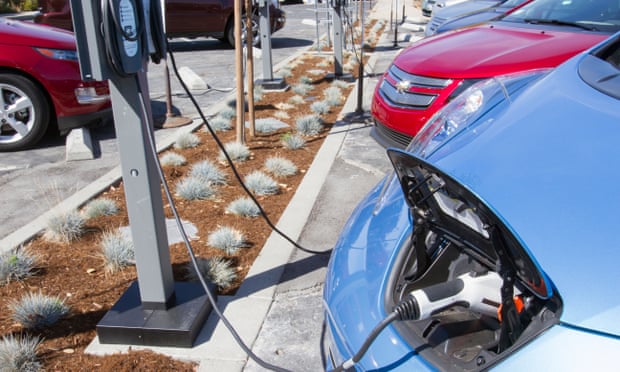
HOW WILL I CHARGE AN ELECTRIC CAR?
The first generation of electric-car buyers have been people with homes where it is easy to plug one in.
Dunsmore envisages charging points becoming ubiquitous at workplaces, and at shopping centres, railway stations, hotels and cinemas. For longer journeys, rapid chargers that can recharge a car’s battery in 30 minutes will increasingly proliferate across motorway service stations and at conventional refuelling stations.
I’M WORRIED ABOUT THE BATTERY RUNNING OUT – SHOULD I BE?
Most mass market electric cars today have a range of 100-150 miles before the battery runs flat. Some of the top-end cars, such as Tesla’s electric sports cars, can run for 334 miles before needing a plug socket.
While that may not sound much compared to the 400-500 miles or more that a petrol or diesel car can manage before refilling, most car journeys in the UK would easily be accomplished in an electric car. Half of journeys are one to five miles; 38% are for five to 25 miles and only 2% are for 50 miles and more.
Of course, some people will need to go much further – and that’s where plug-in hybrids come in, using a petrol engine to run an electric motor after the battery runs out.
Improving battery technology is expected to extend even pure electric cars’ ranges to about 400 miles within a decade.
DON’T THE BATTERIES DIE AFTER A FEW YEARS?
Makers of electric cars sell their models with a warranty for the battery, which will lose capacity over time. In the case of the Nissan Leaf, it’s covered for five years or 60,000 miles, rising to eight years or 100,000 miles for the version with a bigger battery. But yes, eventually you will need to either buy a new battery – by which time their cost should have fallen – or sell the car on.
Electric cars have been around long enough in the UK for a second-hand battery market to be emerging. One energy company, Eaton, is already selling used electric batteries for reuse as household batteries.
понедельник, 8 июля 2019 г.


четверг, 4 июля 2019 г.
05,07,2019 (1500)
Forget to Do
Use forget to do to indicate that someone did not do something:
She often forgets to lock the door when she leaves the house.
I forgot to get the groceries at the supermarket.
Forget Doing
Use forget doing to say that someone doesn't remember something that they have done in the past:
Mary forgets meeting Tim in Italy.
Annette forgot locking the door before she left her home.
Remember to Do
Use remember to do when speaking about something someone should do:
Make sure you remember to pick up some eggs at the supermarket.
I'm sure I'll remember to invite Peter to the party. Don't worry about it!
Remember Doing
Use remember doing to speak about a memory that someone has:
I remember buying him a present.
Jeff remembers living in Italy like it was yesterday.
Regret to Do
Use regret to do in the case that someone must do something that is unpleasant:
I regret to tell you the bad news
They regret to inform us that we've lost all our money!
Regret Doing
Use regret doing to express that someone doesn't like what they did at some time in the past:
Peter regrets moving to Chicago.
Allison regrets falling in love with Tim.
Stop to Do
Use stop to do in order to say that someone stops one action in order to do another action:
Jason stopped to speak with his boss about the convention.
My friend stopped to smoke a cigarette before he continued with the conversation.
Stop Doing
Use stop doing to show that someone has completely quit some action. This form is often used when speaking about bad habits:
I stopped smoking cigarettes.
You should stop complaining about money all the time.
Try to Do
Use try to do to encourage someone to do something:
He should try to learn a new language.
I think you should try to save some money this month.
Try Doing
Use try doing when speaking about an experiment or something that is new:
He tried going to a fitness club, but it didn't work out for him.
Have you ever tried cooking fish in olive oil?
Infinitive or Gerund Quiz
Test your understanding of these differences in meaning by deciding whether the verb should be used in the infinitive or gerund form based on the clues provided:
- Jack remembers _____ (buy) eggs at the supermarket because he always takes a list.
- Jason stopped _____ (play) the piano at six because it was time for dinner.
- I certainly didn't forget ___________ (ask) him the question because he's already given me his answer.
- Janice stopped _____ (make) a telephone call before she continued with her shopping.
- What's the worst thing you regret _____ (do) in your life?
- Have you ever forgotten _____ (get) a present for your wife on your anniversary?
- Alan stopped _____ (drink) years ago because of a serious liver problem.
- I regret _____ (tell) you that we are going out of business next month.
- I remember ______ (play) football when I was in high school. Unfortunately, I didn't play much during the games.
- I don't think I'll ever regret _____ (fall) in love with my wife. We've been married for over thirty years!
Подписаться на:
Сообщения (Atom)