“Did you hear that Sarah stabbed Kate in the back last week?”
“No! I thought they were best friends, what did she do?”
“She told their boss that Kate wasn’t interested in a promotion at work and Sarah got it instead.”
“Wow, that’s the ultimate betrayal! No wonder they’re not friends anymore.”
6. (To) Lose your touch
Literally this means to no longer have the ability to touch or feel with your fingers or hands. But to lose your touch actually means that you lose your ability or talent you once had when dealing with things, people or situations.
We use this when you’re usually good at a certain skill or talent, but then things start to go wrong.
“I don’t understand why none of the girls here want to speak to me.”
“It looks like you’ve lost your touch with the ladies.”
“Oh no, they used to love me, what happened?”
honey comb
How did Sting get his nick name?
The story of how he acquired the name Sting is quite interesting, because there are so many variations of it. Even Sting can't seem to remember how the name actually came about.
The most popular version that appears in most magazines and books is that he was christened Sting while with the Phoenix Jazzmen. The band had a rule that said all band members had to have a nickname.
The name Sting came about due to his wearing a striped gold and black sweater and the band thinking he looked like a bee. Gordon Soloman, the band's trombonist, is the one that most books credit with coming up with the name Sting.
HIT ON, HIT FOR, HIT IT OFF, HIT ON, HIT BACK, HIT sb UP
The president ____________ at her critics in a speech last night.
They ______the sponsors ________a lot of money.
We _______________ immediately and became firm friends.
I suddenly ______________ the solution
She _____________him at the party and they went back to her house.
He always tries to _______me ______ for money when we meet.
To twist someone’s arm literally means to take a person’s arm and turn it around, which could be really painful if you take it exactly word for word. If your arm has been twisted it means that someone has done a great job of convincing you to do something you might not have wanted to to do.
And if you manage to twist someone else’s arm it means that you’re great at convincing them, and they’ve finally agreed to do something after you’ve been begging them.
Tom: Jake you should really come to the party tonight!
Jake: You know I can’t, I have to hit the books (study).
Tom: C’mon, you have to come! It’s going to be so much fun and there are going to be lots of girls there. Please come?
Jake: Pretty girls? Oh all right, you’ve twisted my arm, I’ll come!
4. (To be) Up in the air
When we literally think about something up in the air, we have the idea that something’s floating or flying in the sky, perhaps an airplane or a balloon. But really if someone tells you that things are up in the air it means that these things are uncertain or unsure; definite plans have not been made yet.
“Jen have you set a date for the wedding yet?”
“Not exactly, things are still up in the air and we’re not sure if our families can make it on the day we wanted. Hopefully we’ll know soon and we’ll let you know as soon as possible.”
Literally, hit the books means to physically hit, punch or slap your reading books. However, this is a common English idiom among students, especially American college students who have a lot of studying to do. It simply means “to study,” and is a way of telling your friends that you’re going to study. It could be for a final exam, a mid-term test or even an English exam.
“Sorry but I can’t watch the game with you tonight, I have to hit the books. I have a huge exam next week!”
2. (To) Hit the sack
Just like the first idiom, the literal meaning of this would be physically hitting or beating a sack (a large bag usually used for carrying things in bulk such as flour, rice or even soil). But actually to hit the sack means to go to bed, and you’d use this to tell your friends or family that you’re really tired, so you’re going to sleep. Instead of saying hit the sack you can also say hit the hay.
“It’s time for me to hit the sack, I’m so tired.”
1.35
1. Visitors are asked to abstain ___________ smoking on the premises.
(a) from (b) on
2. She is unavailable at the moment as she is attending _________ an urgent issue.
(a) on (b) to
3. I believe _________ him – he is such a talented and hard-working artist.
(a) with (b) in
4. She took some time off work to care ________ her sick son.
(a) for (b) of
5. I totally agree _______ your opinion – everything you say about this is true!
(a) with (b) for
6. The schoolboy was blamed _______ the broken window.
(a) about (b) for
7. He annoys me because he is always boasting __________ his achievements!
(a) about (b) with
8. The management team is meeting this afternoon to decide ___________ the best solution.
Эффект плацебо — какой-либо эффект, психологический или физический, который препарат плацебо (пустышка) оказывает на человека. Плацебо является одним из важнейших компонентов всех клинических исследований.
При проведении первых клинических исследований возможности нового препарата определялись просто относительно группы людей, которые не принимали лекарств вообще. В настоящее время считается необходимым при проведении клинических исследований иметь третью группу участников, которые дополнительно принимают таблетки, не содержащие активного ингредиента (например обычную таблетку из сахара), чтобы сравнить действие исследуемого вещества относительно эффекта плацебо.
Вот некоторые ключевые факты о плацебо:
эффект плацебо использовался и измерялся в тысячах медицинских экспериментов на протяжении многих лет;
многие врачи признают, что регулярно назначают плацебо;
противоположность плацебо — генерирующий отрицательный, а не положительный исход называется ноцебо;
фармацевтические компании должны доказать, что их новые препараты работают лучше, чем плацебо, прежде чем выведут их на рынок;
цвет таблетки влияет на эффект, который она оказывает: красный, желтый, оранжевый вызывают психостимулирующий эффект, в то время как синий и зеленый — транквилизирующий;
крупные таблетки вызывают более сильный эффект, нежели маленькие;
инъекции вызывают более сильный эффект плацебо по сравнению с таблетками;
точный механизм действия плацебо до сих пор до конца не выяснен.
Why no can be followed by either a singular or plural noun
The reason that no can be followed by either a singular or a plural noun is that it can mean not a or not any. Usually, it means not any – zero – because when we use a negative we refer to plurals, I don’t have any books / I have no books. Negatives have plurals because we are showing nothing of a possible many things.
There are no chairs left to sit on.
No dogs allowed.
He has no scruples.
Most of the time, it is therefore correct to follow no with a plural noun – if it is countable. If it is uncountable, we usually use the uncountable version of the noun, not a plural version (e.g. no butter not no butters).
However, sometimes there is only one thing possible, or we wish to emphasise a particular thing (for example when a singular thing has been asked about); in these cases a singular is more appropriate. Consider the following examples:
I have no wife. (only one wife would be expected)
She has no bike. (she would only expect to own one bike)
Singular nouns can also be more appropriate for emphasis, when no precedes a subject noun – because it may emphasise not a single thing. For example:
No player has won this award more than once.
No man is happy without chocolate.
Collocations of no
A number of common nouns combine with no idiomatically (and wouldn’t use not a or not any). Many of these are uncountable. These collocations include no idea, no time, no doubt, no amount, no reason, no need, no problem, no way, no point, no use, no way, no evidence.
There’s no time left, we have to go.
I have no idea what the answer is.
No need to thank me, it was my pleasure.
These collocations often have idiomatic uses, which may be used differently to countable versions of the nouns. For example, no idea is used to mean no knowledge, but no ideas can be used to mean no creative thoughts or plans.
No – Singular or Plural Nouns Exercise
In the following sentences, decide if no (and the verb to be) should be followed by a singular or a plural noun (shown in brackets).
There __________ at the pond. (ducks)
__________ allowed in the lobby. (child)
I have __________ left. (milk)
You said there __________ we could afford. (car)
That rough man has __________ left. (tooth)
__________ of talking could persuade him to stop. (amount)
The rules state __________ can be taken home. (bottle)
There __________ we can get to the show in time. (way)
If there are __________ left to discuss, let’s end the meeting. (topic)
She taught __________ last week. (new material)
The police took __________ when raiding the building. (chance)
He had to walk because he had __________. (car)
Electric cars: everything you need to know
HOW WILL I CHARGE AN ELECTRIC CAR?
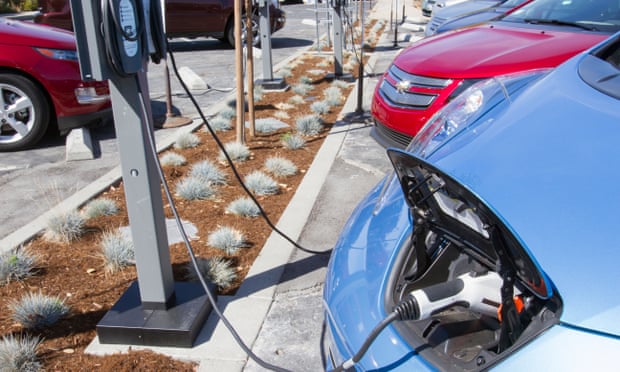
The first generation of electric-car buyers have been people with homes where it is easy to plug one in.
Dunsmore envisages charging points becoming ubiquitous at workplaces, and at shopping centres, railway stations, hotels and cinemas. For longer journeys, rapid chargers that can recharge a car’s battery in 30 minutes will increasingly proliferate across motorway service stations and at conventional refuelling stations.
I’M WORRIED ABOUT THE BATTERY RUNNING OUT – SHOULD I BE?
Most mass market electric cars today have a range of 100-150 miles before the battery runs flat. Some of the top-end cars, such as Tesla’s electric sports cars, can run for 334 miles before needing a plug socket.
While that may not sound much compared to the 400-500 miles or more that a petrol or diesel car can manage before refilling, most car journeys in the UK would easily be accomplished in an electric car. Half of journeys are one to five miles; 38% are for five to 25 miles and only 2% are for 50 miles and more.
Of course, some people will need to go much further – and that’s where plug-in hybrids come in, using a petrol engine to run an electric motor after the battery runs out.
Improving battery technology is expected to extend even pure electric cars’ ranges to about 400 miles within a decade.
DON’T THE BATTERIES DIE AFTER A FEW YEARS?
Makers of electric cars sell their models with a warranty for the battery, which will lose capacity over time. In the case of the Nissan Leaf, it’s covered for five years or 60,000 miles, rising to eight years or 100,000 miles for the version with a bigger battery. But yes, eventually you will need to either buy a new battery – by which time their cost should have fallen – or sell the car on.
Electric cars have been around long enough in the UK for a second-hand battery market to be emerging. One energy company, Eaton, is already selling used electric batteries for reuse as household batteries.


 honey comb